Your Holistic Home: How Your Space Affects Your Energy and Life

I've been asked more than once, "What does a holistic home even mean?" I completely understand the question, because the word 'holistic' is used to describe SO many things. So here goes.
There's a version of home design that's all about aesthetics: the right colors, the right furniture, the right arrangement. A holistic home is about something else entirely.
This is about what your home does to you, how it affects your energy, your nervous system, your mood, and your capacity to show up everywhere else. A space can drain you or hold you up, and most people were never taught to tell the difference.
Your home isn't neutral. It's either working for you or against you.
Most people know there's more to their spaces than what physically meets the eye, but they can't always put it into words. The research on how clutter works on the brain helps to explain some of it, but not everything.
Having said that, a holistic home builds on a cleared one, so if you're drowning in clutter, I'd start there.
What a Holistic Home Actually Means
Cambridge Dictionary defines "holistic" as dealing with or treating the whole of something or someone, not just a part. This reminds me of the medical field, where nurses and doctors are trained in "holistic treatment"- treating the whole person rather than just the symptoms or the physical disease itself.
If somebody comes in fatigued, oversleeping, undereating, and dropping weight, a holistic practitioner doesn't just hand them a pill to gain weight. They look at other possible causative factors, like what's going on mentally and emotionally, and treat the whole person instead of a physical symptom.
I see our homes the same way.
Minimizing, decluttering, and organizing are all helpful and great, but approaching your home from a purely physical standpoint of discarding and organizing isn't the whole story.
It's not a holistic system.
Your environment is one of the main physical components of your life, right alongside your health and your relationships. It's what you're surrounding yourself with every single day.
Holistic > Clutter-Free
So when I say a "holistic home," I mean a space that's not just bare and empty. Clutter-free is part of it, but your space also needs to provide a supportive vibe.
It should give you the energy you need for whatever happens in that particular space. That might be calming energy, inspirational energy, productive energy, and those are very different things.
You might need a bathroom that feels spa-like and relaxing because that's where you go to do self-care and rejuvenate. You might want your office to feel inspiring and energizing with poppy colors, because that's where you go to wake up, focus, and produce.
Your needs change from space to space, but it's still one holistic, supportive system if it's giving you what you need overall.
That means the physical side is handled, with a layout and functionality that serve you. And it means the space gets you into the right mental state, bringing out the version of yourself you want to show up as in that room.
Think of a streamlined office with tons of natural light and a few plants. Now compare that to an office that feels like a cave, with papers everywhere and sticky notes covering the computer screen.
Where would you feel like the most professional, creative, productive version of yourself?
A huge part of creating a holistic home is creating an ambiance that supports you being the best version of yourself for that space.
How to Create a Holistic Home
The way I teach holistic clutter-free spaces is broken into two aspects. The first is a holistic system for getting the clutter out to begin with: considering your mental attachments, understanding the emotional process of letting things go, physically decluttering, planning for the flow and ambiance of your spaces, and factoring in your routines and habits.
The second aspect is living in and experiencing your space in a way that feels wholly supportive to you.
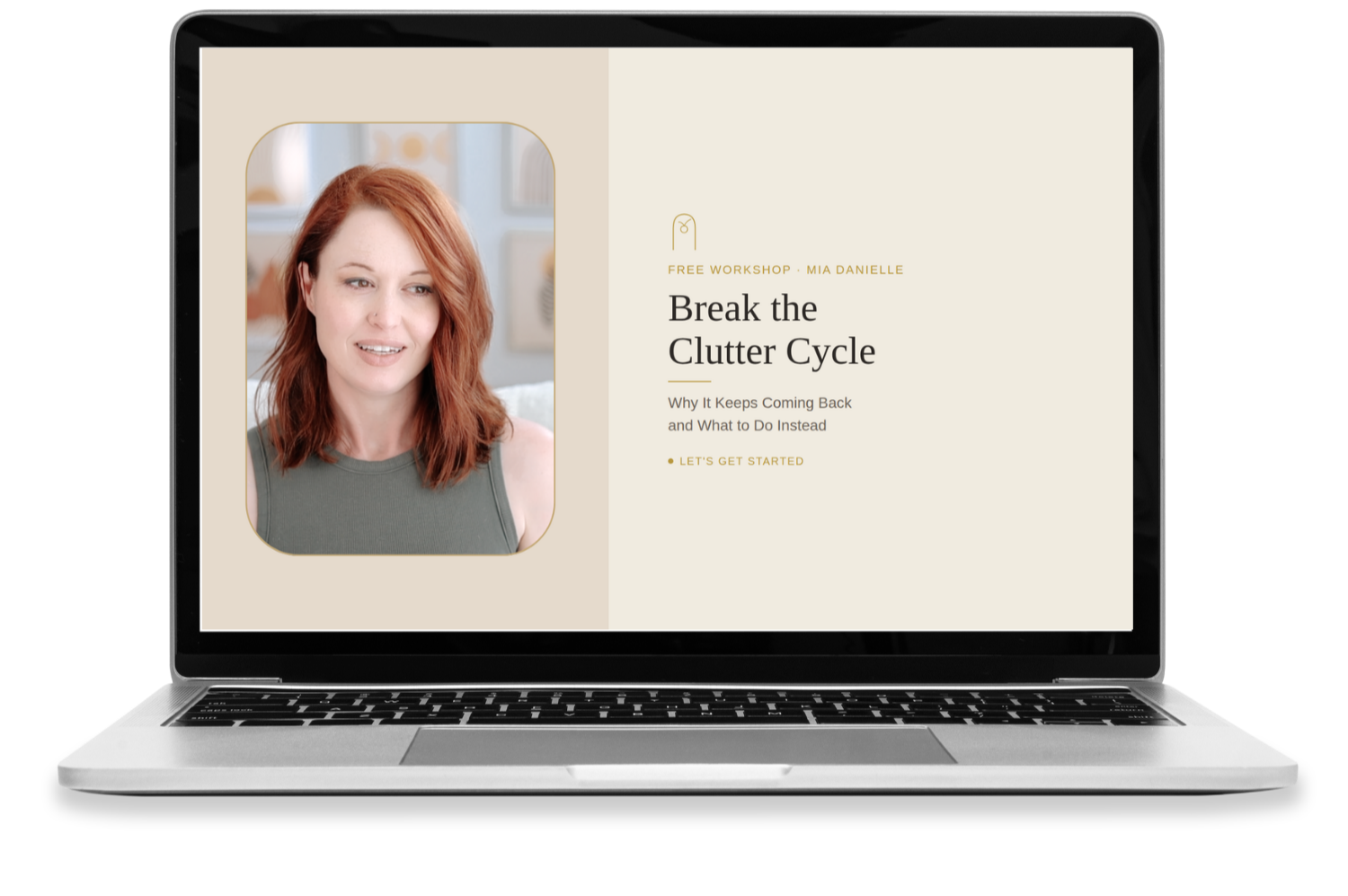
I walk through that first aspect, the holistic decluttering process, inside my free masterclass, Break the Clutter Cycle.
Finding a Supportive Sweet Spot
Drowning in clutter doesn't feel good. It results in anxiety, stress, and high cortisol levels. It leads to arguments with the people you love and can even cost you money.
But overly sterile and empty spaces have also been shown to cause tension, especially with other members of the household who don't necessarily jive with that type of environment.
So the goal is a more supportive sweet spot that goes beyond the clutter, where everyone can be healthy, happy, productive, and supported in their daily flow.
Getting specific about that sweet spot starts with the four key components of a supportive space, the pieces that decide whether a room holds you up or wears you down.
Once those are in place, there are eight must-have elements that make the biggest day-to-day difference in a supportive minimalist space.
How Your Home Affects Your Energy
Most people notice when a space feels off. They just can't say why.
That feeling isn't imaginary. It comes from layout, light, visual load, how traffic moves through a room, and what's sitting in your eyeline when you're trying to rest.
I've walked into rooms that put me at ease before I even set my bag down, my shoulders dropping without me deciding to relax them. I've been in others that put me on edge before I could point to a single thing wrong.
You can learn to read what a space is doing to you, and it usually comes down to a few specific things working against you at once.
Some of the biggest drains are ones you'd never think to blame for your mood, the kind of hidden ways your home drains your energy that once you spot them, you can't stop noticing.
Clutter is one of the clearest examples, because its pull on you isn't vague. There's an actual mechanism behind how clutter impacts your energy, and clearing even a fraction of it hands that energy back for the things you'd rather be spending it on.
But drains aren't only about stuff sitting on surfaces. A big one hides in plain sight, in the sheer amount your eyes have to process before you even sit down, which is exactly why reducing visual clutter in your home changes a room's energy even when nothing structural has moved.
Alignment is the piece that pulls all of this together. A home that made sense five years ago might not fit who you are now, and that mismatch is its own drag on you even if you can't put your finger on it.
Closing that gap is really about practicing alignment in your home and life, making the space around you match where you're actually headed instead of where you used to be.
Making a Home Feel Good
A home can feel cold if you strip it down without thinking about what you're left with.
The homes that feel good aren't the ones with the least in them. They're the ones where everything present is actually doing something for you, a throw blanket you reach for, a candle you actually burn, plants you actually keep alive instead of ones that just sit there looking sparse.
That's the real difference between a home that's simple and a home that's simply empty. One is built through deliberate choices. The other is just less, with nothing added back in its place.
Getting there isn't complicated, but it is intentional. There are specific moves that make even the most minimalist home cozy, from texture and lighting to the scents and sounds that make a room feel like somewhere you want to land at the end of a long day.
The Energy a Space Carries
I don't throw around the law of attraction framing carelessly, but there's some truth in the idea that the energy of a space shapes what you draw toward you.
A heavy, stuck, overcrowded home tends to breed a certain mental state, and you can benefit from leaning into that link instead of pretending it isn't there.
That link works in the other direction too. A new season, a closed chapter, a fresh beginning all find their footing when your space reflects the shift instead of staying frozen in whatever came before.
That's why clearing out your home for a fresh start is so powerful. You're using the space to mark the turn on purpose instead of waiting for your feelings to catch up.
What surprised me most about Japanese living is how it challenged assumptions about what a home actually needs to function according to US standards (where I live).
Home and Emotional Wellbeing
The connection between your home and your mental state isn't metaphorical; it's physiological. How a space is arranged, how much visual input it throws at you, whether it reads as calm or overstimulating, all of it lands directly on how you feel and function.
This isn't abstract for me. When I started, I was a single mom with two little girls, and I'd struggled with years of anxiety and depression, ups and downs, and unpredictable energy patterns.
Despite all of the chaos, I had enough insight to know that I needed a home space that was going to majorly help me hold things together. And one that was not going to fall apart anytime I needed to take a break.
Years later, I can say it worked. When your space is right, hard days are still hard, but they don't have to spiral.
Environment-First Tools
That uninspired, bone-tired feeling usually has environmental roots that are easier to reach than they look. When you feel uninspired and exhausted, changing one thing in your space is often the fastest way to interrupt the pattern.
That same environmental lever shows up on a bigger scale with anxiety and burnout, which run on seasonal rhythms for a lot of people. The home can ease that rhythm or feed it, and the environment-first approaches to self-care for anxiety and burnout hold up year-round.
Outside of anything tied to a season, the anxiety relief tips and tools you don't hear about tend to be environmental and behavioral, too, the kind most mental health conversations skip past in favor of mindset work alone.
Some of the heaviest clutter fits that same pattern without being physical at all. There are things to declutter for emotional health that have nothing to do with objects but still take up space in how you feel.
Put all of that together, and it points to something bigger than any one fix: your environment either supports your baseline mood or works against it. The environmental side of what happy people do doesn't get talked about enough, but the habits of happy people are a lot easier to keep up in a home that's actually set up to support them.
Movement, Mindfulness, and Space
How you physically move through your home is part of how it affects you energetically. Blocked pathways, furniture that interrupts the flow of a room, spaces that don't invite the activity they're meant to hold. All of it adds up.
A room that's hard to move through is a room you'll avoid. A room that flows well pulls you in without you thinking about it.
That's why layout matters as much as what's in the room, and it's the piece people skip when they're busy decluttering objects instead of looking at the space itself.
Mindfulness in a home is less about a meditation cushion and more about actually being in the room you're in. A space that's calm and easy to move through makes that kind of presence the default instead of something you have to force.
You can even do a kind of yoga for your home, taking the same ideas of flow and intentional space and pointing them at your rooms. It's a far more useful frame than it sounds.
Self-Care That Starts With Your Environment
Most self-care talk focuses on what you do: the bath, the walk, the journal, the meditation practice (btw, I have a whole article on tiny self-care habits you can do right there at home that nobody talks about). Less of it looks at the environment you're doing it in, which matters just as much as the practice.
If you're trying to rest in a space that feels cluttered, unfinished, or draining, you'll go through the motions of rest without actually getting there. The environment either supports the practice or competes with it.
My meditation practice is the clearest example I have in my own house. I put my bed into zero-g, turn on the vibrations, and sink into a good body scan or serene meditation. Ok, it's a bit excessive, but I'm committed!
I get so much more out of it than if I were just to sit and try not to think of anything. I give it a scene.
A home that supports you is self-care infrastructure. When it's in place, rest actually restores you, focus lands, and the routines you've been trying to build finally have somewhere good to live.
Ease isn't really about square footage; it's about how a room reads. There are ways to make a small room feel more spacious that work even when the home itself is tight.
Get the space right and everything you do inside it gets easier.